Showing posts with label Cambodia. Show all posts

December 19, 2012

70 Days In Southeast Asia

ON SOUTHEAST ASIA…
A very dear friend of mine told me before we came here, "You will feel that anything is possible in these places." Southeast Asians are innovative and savvy, but sometimes in very antiquated ways. Their exotic food, architecture, religions, style of dress, and unusual customs do leave a lasting impression of inspiration. 


That said, these places are not exactly easy to travel through. The language barrier, road conditions, traffic, heat, hassle-factor, and ethical code can all be a challenge. We're glad we've come here now…because later in life when we want to take a vacation from work, we don't want to have to work at our vacation.

As with other areas of the world, we're always amazed at how they assign values much differently than we do at home. In Thailand, an hour massage costs the same as a load of laundry. Once we were in a country for just a few days, we picked up enough to play their game. All of a sudden instead of the sales person telling us a price, we would tell them the price that we knew was appropriate. They almost always accepted our bid.

The majority of tourists in Southeast Asia are European...lots of French, German and Dutch abound. But the common denominator for communication is English. So it got us thinking, can you imagine going on vacation and having to speak your second language the entire time?  That would be so tiring! We had a hard enough time understanding Asian English…what about a French person trying to comprehend what a Vietnamese person is saying in English?

Among the four countries we have observed similarities…most notably the burning of trash. However culturally speaking, Thailand, Cambodia and Laos have the most in common. Vietnam is the outlier with much stronger ties to China. For some deranged reason, Laos and Cambodia were actually more expensive than Thailand and Vietnam. They may be dirt poor, but they certainly know how to grossly overcharge tourists.

I can't imagine trying to take a carbon-neutral trip to Asia. You'd have to donate your entire life savings to make up for the smog coming out of these vehicles. Here's a quick introduction to some of the more unusual forms of transportation we've taken:

Tuk tuk (Thailand, Laos, Cambodia) – 3-wheeled motorcycle with a carriage strapped to the back 


Songthew (Thailand) – pick-up truck with a roof and two facing benches in the back.


Cyclo (Vietnam) – 3-wheeled bicycle with a seat either in front of or behind the peddler. 
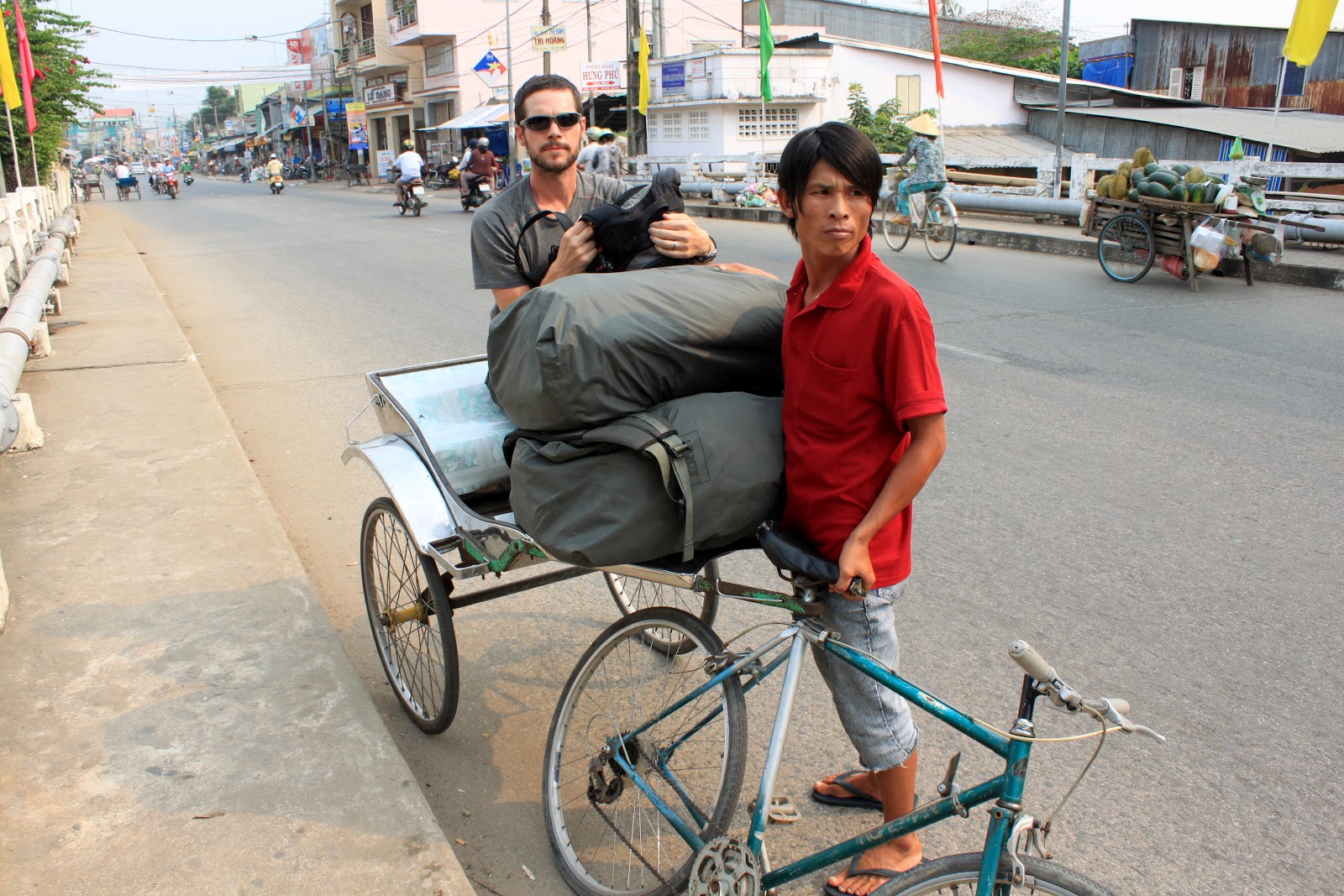

Sometimes we've felt that we were living in a real life game of Mario Cart…Southeast Asia edition. We got to pick our board: Thailand, Laos, Cambodia, or Vietnam. We got to pick our vehicle: tuk tuk, songthew, cyclo, motorbike, taxi, minivan, bus. And then we were off! We raced around the streets, weaving in and out of traffic, passing and being passed.

Vietnam gets the award for the most people on one motorbike…5. It's now a law that adults have to wear motorcycle helmets, but kids? No helmet, no big deal. The kids look like dogs who stick their heads out the window. They just peer around in awe taking in the world around them.


When walking through traffic we learned to just pick a line and GO! No slowing down, hesitating, or changing course. They would adjust to us, and it was scary every time.


Whenever there is a traffic accident, they don't put out cones or flares. Instead they lay tree branches on the road.

Sanity is not always a top priority. Our Dutch friend Gerard snapped this unbelievable picture on our boat trip down the Mekong in Laos. Fish for dinner, anyone?


We rarely saw an overweight person. There is hardly any graffiti. They fill their water bottles up to the VERY top. They are short…Steve has hit his head too many times to remember and has actually drawn blood about 5 times.

They're so afraid of the sun that on long bus rides they'll cover up their windows with curtains, even if it means missing the entire journey.

We watched a family hold each other tight and just bawl as they said goodbye to one of their loved ones at the airport in Laos. It absolutely broke my heart. Many of these people have nothing but family. Unlike in Bolivia where the men are nonexistent and you don't even see mothers interacting with their children, it was evident how strong the family ties are in Asia.

SOUTHEAST ASIA VS. SOUTH AMERICA...
In many ways what we've seen in Southeast Asia is very similar to South America…stray dogs, hand labor in rural farms, janky sidewalks, backpackers following the exact same trail, and hawkers uncomfortably staring at us thinking that this brilliant tactic is going to close the sale.

In other ways it's completely different from South America. The big cities are more advanced. We have worried about getting hit by traffic, but we have never once felt fear of crime. We think that Southeast Asia felt safer because night markets and eating outside on the streets are so common in their culture. In South America, if people were roaming the streets at night, it's because they were up to no good.

In the battle of the developing continents, the winners are…

  -  Harm by violence: South America
  -  Harm by traffic: Southeast Asia
  -  Air pollution: Southeast Asia
  -  Garbage: Southeast Asia
  -  Public urination: South America
  -  Cockroaches: Southeast Asia
  -  Family fun: Southeast Asia
  -  Stray dogs: South America
  -  Friendliest: Southeast Asia
  -  Biggest scams: Southeast Asia
  -  Biggest thieves: South America
  -  Most religious: South America 
  -  More expensive: South America
  -  More English: Southeast Asia
  -  Hardest workers: Southeast Asia
  -  Most beautiful landscapes: South America
  -  Best food: Southeast Asia

We have debated many times how our impressions of these continents would differ if we had done Southeast Asia at the beginning of our trip and South America at the end. Certainly we are more experienced now, and that has affected our experiences in ways we can't really understand.

ON OUR STATE OF WELL-BEING…
After 9 months on the road we felt we had really begun to master the tricks of traveling. We knew how to get around efficiently and how to make the right choices for us. That is, until we got to Southeast Asia. Things were just different here, and we were thrown back to day 1 as we tried to figure it all out. We made a lot of mistakes, and it was personally really frustrating. We took the Laos cities out of order and ended up back tracking. We picked the wrong islands in Thailand and paid for it with sub-par landscape and bad weather. We missed opportunities in Vietnam because we didn't have our days planned far enough in advance. It's not that any of these were a huge deal, but we just felt as though we should have known better by this point.

We are excited to announce that we were not victims of a stray dog bite! This happened to two of our friends while on bicycles and they had to go through rabies vaccinations during their vacations. We heard that temple dogs were the most desperate.

Before we started our trip we said we wanted to live like kings in Southeast Asia. Ha! I wouldn't go that far! There are some very upscale hotels and restaurants that are way out of our league. Instead I will say that we've been well-taken-care-of backpackers. We have stayed in private rooms, eaten at nice restaurants, and been able to afford the services of a guide or driver for the entire day if we wanted. I'm proud to say that we didn't always take the easy way out. As always, eating, traveling, and shopping like a local provided a more genuine (if not memorable) experience.


December 18, 2012

Business, By Southeast Asia

It's true that over the past 2.5 months, the Southeast Asians have awed us with their work ethic. If people work this hard in countries where there is so little, we dream about what we can do in our own country with just as much determination.

If you know us, you know we're always on the lookout for business ideas. Luckily, we have been inspired by the savvy Southeast Asian business practices and will model our future company accordingly. I hope you can pick up on sarcasm…here we go:

When we get home we've decided we will sell incense sticks outside the grocery store 
(AKA the market). We will refer to ourselves as “a village”, a clever term which sounds more interesting than it really is. We will watch the tour buses roll in.


We will employ clever marketing tactics such as telling people that they will buy from us. When they say no, we will not respect their decision and will give them no personal space by following them around asking in an angry tone of voice, “Why not?”. We may even walk directly in front of them in an attempt to trip them up. Surely this will persuade them.

We will not think of people in terms of “shoppers”. If they enter our village, they are buyers and we will treat them that way.  

We really hate it when buyers think they're being courteous when they say, “No, thank you.” If I hear that one more time, I will mock them by repeating, “No, thank you. No, thank you. No, thank you,” in the snottiest tone I can muster.

Like bugs to a light, we will attract buyers by putting out fake product arranged in colorful and fanciful displays. This will mesmerize and fool them all at the same time.


We will not label the price of our incense sticks. This will require the buyers to verbally ask us the price, wherein we can begin the negotiation. We will price our goods 5 times higher than any reasonably educated person would pay. If they balk at our prices, we will tell them that our incense sticks are handmade. We will even employ a fake craftsman to sit inside our village and pretend that she is rolling the incense onto the sticks.


If business is not going well, we will attribute it to one of two things: (1) an outlandish Chinese proverb or (2) a lack of competition. To remedy this, we will invite four other incense stick partners to set up shop right next to us. We will refer to them as our cousins and will work closely with them to ensure price fixing. We will also make sure that the merchandise in all five shops is coming from the exact same supplier (in China). We don't want anyone mistaking that our products are better than anybody else's. The more people we have selling incense sticks outside of the grocery store, the better off we'll be.

Why go back to school when we already have a SEA MBA?

December 8, 2012

The Kingdom Of Cambodia

One of our favorite things is the first day in a new country. We're on a high of excitement as each passing minute uncovers realizations about our new home. What kind of food is available? How much do things cost? Is there decent Internet connectivity? How many people speak English? What are some key local phrases? How good are the maps? What's the currency conversion? Can we drink the water? These are the moments when we're learning our new normal, and it's exciting. We will miss this greatly, as entering Cambodia was our last new country on this RTW adventure.

We started out Phnom Penh, which for a capital city, has a surprising number of naked kids running around. There are also a shocking number of people missing limbs…perhaps a result of Cambodia being the most densely landmined country in the world.

Cambodia has such a recently dark past, and there's no better place to learn about it than in Phnom Penh. From 1975-1978, it was here that a genocide was orchestrated which killed 2 million out of 8 million Cambodians in less than 4 years. The Khmer Rouge (AKA the bad guys), systematically wiped out anyone who was educated along with their families. Even people who wore reading glasses were deemed intelligent and thereby executed.

We visited the S21 Prison (formerly a high school) where innocent Cambodians were brought to be interrogated, tortured, and made to admit crimes they didn't commit. 


Once they gave their confessions, they were transferred to Choeung Ek, also known as 
The Killing Field. There are hundreds of killing fields all across Cambodia, but this particular one, just 15 kilometers outside the capital city is the most famous. 20,000 Cambodians were killed and buried in mass graves here less than 40 years ago. There are bones, teeth, and scraps of clothing still rising up to the surface each year as rains adjust the soil.

 
Surprisingly the Cambodian people are not reluctant to talk about it. They very much take the stance that if it's not openly discussed, it will be forgotten. They want everyone to know what happened so that it doesn't happen again.   


To tour these two sites we reunited with Chan, our tuk tuk driver from the day before, who turned out to be an honest and hard-working guy. We talked with him over lunch about his uncle who was killed in the genocide (because he was studying medicine) and his parents who were spared (because they were so poor and uneducated). Chan beams when he talks about his 8-year old daughter who ranks at the top of her class. He has to meet a quota of $15-25 per day to pay for his kids' school and family expenses. We hired him to drive us around for the entire day at the rate of $15. Because he was a good person and didn't try to scam or up-sell us, we gave him more. He could not have been more appreciative.


The roads here are in really bad condition. We jokingly wonder how many months have been taken off of our lives from all the smog, exhaust, and dirt we breathed in along the way.


It's fun to see a country that is 95% Theravada Buddhist with Christmas decorations on every other street. 


Cambodia's long-reigning king died just two months ago, so his picture hangs with black and white flowers all over the country. 


His body is lying in state in the Royal Palace, so it was off limits to the public. Instead we got to see the neighboring Silver Pagoda courtyard.


It was also in Phnom Penh that I realized I had miscalculated our days. We had to cram a leisurely 2.5 days worth of sightseeing into a frenzied 1.5 days so that we could get north to the Angkor temples in time for Steve's birthday.

It was a 5.5-hour drive from Phnom Penh to Siem Reap on a minibus, and once again, we were shocked at the road conditions…stemming from the capital city no less. 


If the vehicles would even remotely stick to some form of a lane, it would go a lot faster. But instead they all bunch up on a two-lane dirt highway. When an oncoming car plays chicken for long enough, they are forced to slow down and spread into a phenomenon called a single file line.

Things got really interesting during the last two hours when we had to drive through the dark, dodging pedestrians, bicycles, cars, dogs, and potholes. I always request to sit in the front seat because it helps with my motion sickness. Steve on the other hand would prefer to sit in the back. He can't bear to watch us drive straight into oncoming traffic at 60 mph and then swerve away at the last second. It's true; this kind of Cambodian driving would normally give us heart attacks. We still feel anxiety, but I have a hunch we've softened to it a bit by now.

Driving through the countryside was as fun as always. 85% of Cambodians are farmers and 90% of the land is for rice. The countryside is dominated by flat rice patties accentuated with thousands of tall palm trees.
  

Every country house is set high on stilts and has either a lily or lotus pond in their front yard. We passed babies in the front baskets of their parents bicycles and dusty roadside wedding receptions with women dressed in their fancy ethnic two-piece dresses. We also saw a few ponies pulling carts of hay along the way. Whoa…it totally took us back to South America where they are completely dependent on the horse. In Southeast Asia they prefer the water buffalo.

The bugs here are BAD, and we're not talking little mosquitoes. These are big, scary, hopping, hard-shelled insects. We are feeling a little jumpy these days. And speaking of bugs, they are definitely a part of the Cambodian cuisine. They eat big bugs at least 3 inches long, and humongous black spiders, too.

We preferred to stick with the traditional specialties of Lok Lak (well seasoned strips of beef served with onions, tomatoes and rice) or Amok (a custard of curry, coconut milk and fish served in a banana leaf bowl). We ate these two dishes every single day while we were in Cambodia and still weren't sick of them.  


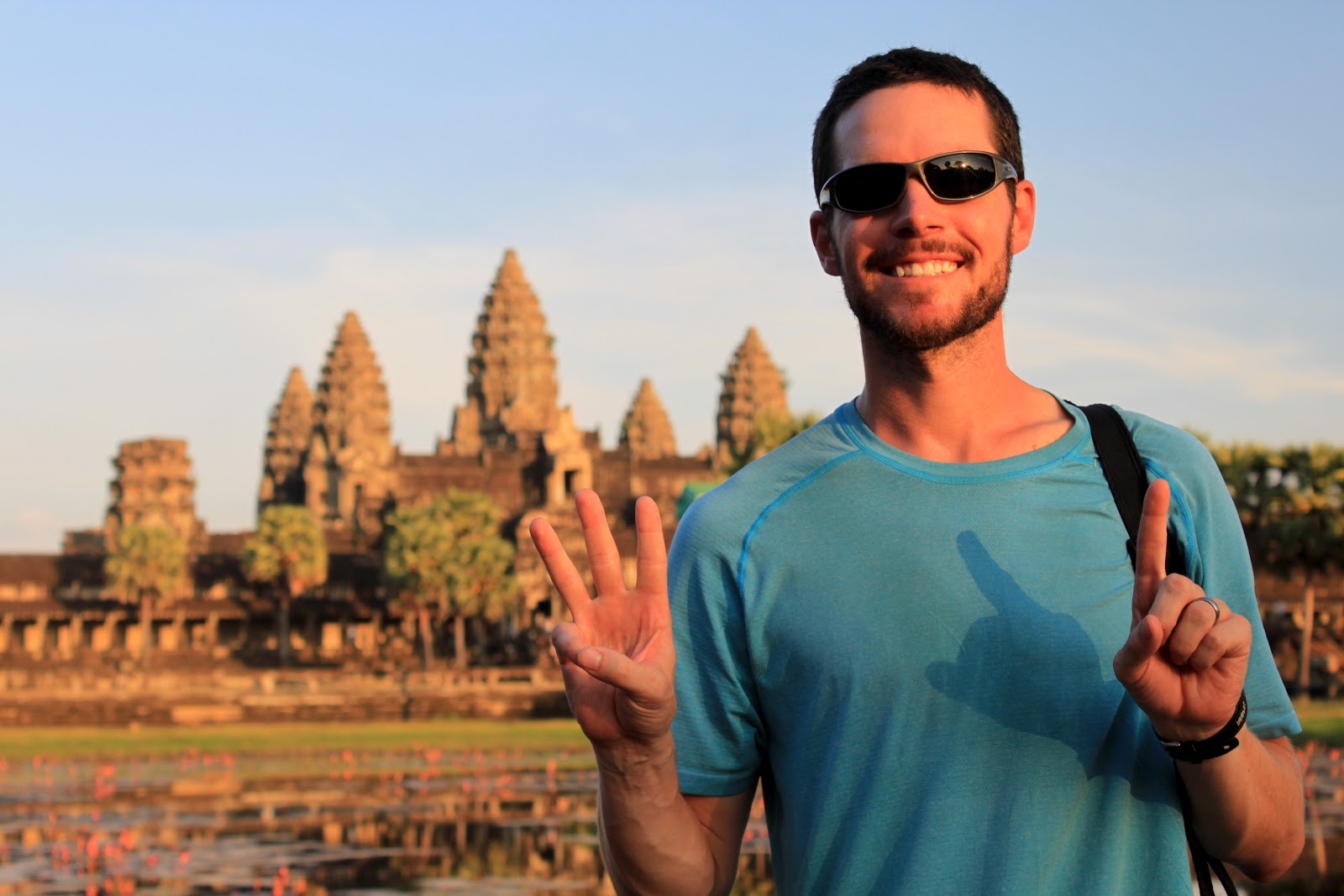
Since we celebrated my birthday at Machu Picchu, we figured what better way to celebrate Steve's than at Angkor, the greatest collection of ancient civilization in Southeast Asia. It was the center of the once powerful Khmer Empire which began in the 9th century – some 700 years before the Incas and Machu Picchu. 


There are more than 100 ancient Khmer temples concentrated in the area around Siem Reap, and over the course of two days we toured through 16 of them. This is where the movie Tomb Rader was filmed, and it's easy to see why. This is no cleaned up Machu Picchu. These are jungle ruins left nearly as they were found. There has been some conservation work done, but it is largely wild and truly incredible.


These temples don't feel like the safest places in the world. They looked like they could cave in on our heads at any moment. In some places they're barely keeping it together.


Trees have begun to overtake the temples – baring a striking resemblance to an octopus wrapping its tentacles over and around the ancient buildings.


Near the entrances, landmine victims form bands and play traditional Khmer music to set the mood. They are accompanied by a symphony of cicadas so loud and shrill that they sound like a tile saw. The hawkers lurking around the temples are out of control, but once inside, the fun routes to explore were endless.


Occasionally we would hit dead ends. 


It's hard to explain the scale of the Angkor temples. There are intricate carvings, not just saved for specials places, but which cover entire complexes. Today they are draped in moss, adding to the magic of it all.


In case you ever make the voyage, here were our favorite temples (in order):
 
Preah Khan – you could spend two hours here scrambling through the endless maze of ruins.

 
Banteay Kdei – another super fun one to explore, despite the fact that hardly anybody comes here. 


Bayon – endearing because it has 4 large stone faces on each side of its 54 towers. That’s 216 faces to delight anybody with a camera.   


Angkor Wat – easily the most famous of all Angkor temples, but the only reason is maybe because of its name and size. From a temple perspective, it's not nearly as fun to visit as the others, but it's still a must-do. Whether from a neighboring hilltop or in front of its lily pad pond, Angkor Wat is best appreciated for it's incredible beauty from a distance. At sunset, the light makes it glow.


Ta Phrom – famous for its overgrown trees, but it was under a lot of construction when we visited. It's overrun with tourists, so it is a bit harder to enjoy. 


Banteay Srei – a long drive outside of Siem Reap. Known for it's intricate carvings, it's also small and too crowded with tourists. You've been warned. Best to arrive sometime after 9:30 and maybe you'll have it all to yourself.

  
In general we found that the temples where there were the least amount of tour groups were most enjoyable. 


A fellow traveler in Vietnam had tipped us off to Golden Butterfly Villa, a hotel in Siem Reap that is only 2 months old. For $25 per night, we were treated like royalty. Every time we came home from the temples they showered us with cold Khmer tea, snacks, wet cloths to wash our hands, and warm welcoming smiles. It's been a long time since these two travelers experienced luxuries like this!


On Steve's birthday, they surprised him with a cake and a bowl of exotic fruits. What a memorable moment as three Cambodian hotel staffers sang him Happy Birthday in our room. 


That same night we had Khmer foot massages on the street and then the next day complimentary massages back at our hotel. This particular form of Cambodian traditional massage involves a lot of slapping of muscles. It's actually quite funny.

Ancient temples, surprise cake, and being slapped around by Cambodian women. What better way to spend your special day. Happy Birthday Steve!