March 16, 2012

Uruguay…Why Not?

Buenos Aires is so close to Uruguay that it would have been a shame to miss it. There are ferries that run between the two countries every day, so we decided to take a 3-day side trip to check it out.

From Buenos Aires there’s a quick 1-hour ferry, but we opted for the slower and cheaper 3-hour boat ride across the mouth of the Rio de la Plata. The river is so vast that it gives the illusion you’re in the middle of a brown ocean. The boat was a miniature version of a cruise ship, and it was a no-hassle hop, skip, and a jump into Uruguay.


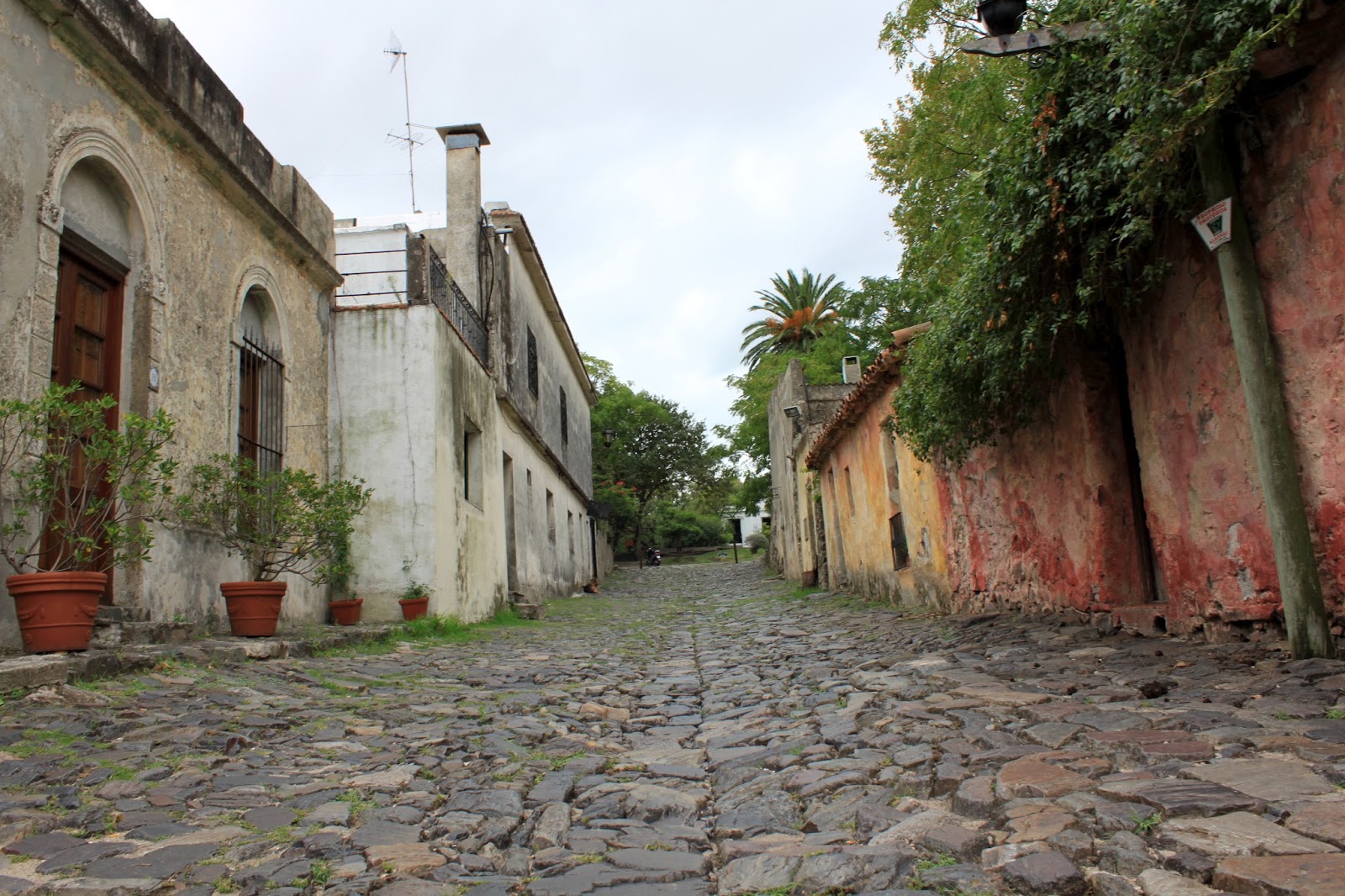
Our first stop was Colonia del Sacramento, a 17th century Portuguese colony, which is the oldest town in Uruguay. We enjoyed walking around the old section called Barrio Historico. We strolled along the waterfront promenade, saw the original city wall and drawbridge, walked amongst the ruins of a monastery, and climbed up into the lighthouse. From the top of the lighthouse, we got a good feel for how small the original town must have been. We could also just barely make out the cityscape of Buenos Aires from across the river. Beyond spending an afternoon in Barrio Historico, there is not a ton to do or see in Colonia del Sacramento. It’s a city to simply enjoy on foot as you meander the tree-lined cobblestone streets.



 The next day we took a 3-hour bus ride to Uruguay’s capital, Montevideo. We started off walking around their historic center (Ciudad Vieja) and many plazas. We saw a lot of their important national buildings such as the Supreme Court, Office of the President, Statue of Liberty and the original city gate. On two occasions, we were walking by the Stock Exchange when a horse-drawn wagon trotted by. We could also hear the clip-clop of horses from inside our hostel at night. Given all of the construction that we saw, we got the impression that this is a city (and country) trying to put one foot towards the future with one foot still in the past.


On our last day we hopped across town to a neighborhood called Pocitos to go to the beach. This turned out to be a nice residential community where we ate lunch and shopped the fruit stands. We discovered that children in Uruguay also wear white lab coats to school, but they've added a piece of flare in the form of a massive navy blue neck bow…even the boys.


One of the highlights of Uruguay was the food. We had our best empanadas to date…made to order from a little restaurant in Montivideo’s Ciudad Vieja called El Rincon. We also discovered three brand new foods.

Milanesa is a very thin patty typically made of beef or chicken. It’s soaked in egg and then breaded and fried. It can either be served on its own or as a sandwich.


Chivito is the Uruguayan version of a hamburger…but even better. It was stuffed with meat, lettuce, tomato, ham, egg and cheese.


Finally, in our effort to taste test ice cream flavors from around the world, we sampled Sambayon. It’s a bright yellow ice cream made of vanilla, wine and raw eggs. The taste was unique, but not yummy enough to bring back to the US.

We also felt compelled to drink Uruguayan wine. We can tell you that there’s a reason Uruguay isn’t known for wine making. Neither of our bottles was very good, but we did get to try a new varietal called Tannat.

And a recap of Uruguay would not be complete without mentioning Mate. Yerba mate is a loose herbal leaf, reminiscent of tea, but served in a squash gourd called a mate. After the leaves are placed in the gourd, hot water is added and the drink is taken via a metal straw called a brombilla that has a filtration system on the end. While mate is very popular in Argentina, it is an obsession in Uruguay. Everyone is ubiquitously carrying around their gourd, brombilla, and thermos full of hot water. It’s amusing to see grown men coveting their mate gourds in the same way that a baby needs its bottle.

The weather forecast for our 3-day Uruguayan escapade was calling for 100% heavy rain showers. We had even considered calling the trip off, but we’re so glad that we didn’t. It didn’t rain a single drop the entire time, and in return for our steadfastness, Uruguay blessed us with sunsets like this.

March 13, 2012

March 12, 2012

The Chocolate Box

When in South America, do as the South Americans do and go to a soccer game!

Soccer is the Argentines’ number one passion. So much so, that there are people who have erected a church just to pray to Diego Maradona – the legendary Argentine soccer player from the 1980s. Fans are so passionate, that it’s highly recommended for foreigners to only attend a game with a guide. We did our research and decided that, since we’re here, we should see the most famous team in the most famous stadium…

Historically, Boca Juniors is considered one of the greatest soccer clubs in the world. They are based out of the colorful La Boca neighborhood that we visited last weekend. Their stadium has a really boring official name that no one uses, but it’s more commonly referred to as La Bombonera or “The Chocolate Box”.


The Boca Juniors club has over 100,000 members, but La Bombonera only holds around 55,000 spectators. There aren’t enough tickets for the members, let alone the general public. Because we chose to see a rivalry match – known as a “Classico” – the tickets are even harder to come by. This is another important reason to go through a guide. If a foreigner goes to the stadium and tries to scalp tickets, they will most certainly pay a pretty penny for counterfeits.

We were picked up by our guides and driven, along with about 20 other foreigners our age, to La Boca. When we were about a block away from the stadium, we got out of the vans and were strangely ushered into a private garage of sorts. Here they proceeded to serve us beers from a couple of pitchers and choripan (sausage in a hot dog bun), being cooked by what looked to be the guide’s relatives. We were all laughing about how ghetto it seemed, and then the guide kicked it up a notch. He went around handing out our “tickets” to the game…plastic cards that I’m sure were season ticket passes. While entering the stadium for the Boca Juniors vs. Independiente match, Steve was Rafael Jimenes Merino and I was Carlos Eduardo Jimenez.


Upon entering the stadium, our first impression was that it is small. The Boca Juniors club didn’t have much land to build the stadium on, so the field is the smallest regulation size allowed by FIFA, and only three sides of the stands are curved.


The stadium’s unusual shape means that it has good acoustics, and one whole end of the stadium is completely tricked out with banners dubbed La Doce or “The 12th Man”. Our guide consistently referred to the fans in the La Doce section as “hooligans”.


La Bombonera is notorious for vibrating when fans start to jump in unison, leading to the phrase, “La Bombonera doesn’t shake…it beats (like a heart)”. We experienced the beating heart first hand. We were seated behind one of the goals in the second tier just under the third tier’s overhang. Whenever Independiente’s fans on the third tier began jumping, we could visibly see the entire overhang bobbing up and down over our heads.

La Boca fans are just that…fanatical. They stand and jump and sing the entire game. They also have very aggressive hand motions, that when gestured in unison, could be mistaken for Nazi Germany.


It turns out that they don’t serve beer in the stadium. They also don’t serve it in a 20-block radius of the stadium starting 4 hours before the game until 2 hours afterwards. So these fans aren’t crazy because they’re drunk; they’re crazy because they love their team.


At the start of the game, there were two white inflatable tunnels leading onto the field. We figured these would be for the two teams to emerge from their locker-rooms. We were wrong. The Boca Junior players actually appear through a small underground staircase at midfield. One of the tunnels is for the opposing team and the other is for the referees. They have to have these so that the fans don’t hit them with bottles as they come onto the field. The fans don’t boo…they just whistle in a heckling sort of manner and try to throw stuff at the opposing team.

As the Boca Junior players were being announced, loads of huge confetti was thrown into the air and all over the field. Three guys with leaf blowers came out and did a mediocre job of blowing about 60% of the confetti off the field before the start of the game.


There was no national anthem. There were cheerleaders, but only for the home team. Half of them were wearing the standard cheerleading miniskirt. The others were wearing thongs. For the record, there was no halftime show…unless you count the cheerleaders strutting down the field waving their pompoms in the air.


So enough about all of the fanfare...how was the game? Apparently we witnessed something historic. Within the first 7 minutes, Independiente caught La Boca completely on their heels and they scored two goals. Then La Boca started making a comeback and the lead kept changing hands. Regulation time ended and the score was 4-4. During the last 5 seconds of add-on injury time, Independiente scored the winning goal. Normally Classico matches are 1-0 or 2-0. To have such a high-scoring Classico game is highly unusual. Regardless of the loss, we're considering ourselves lucky.

March 11, 2012

Drama, Drama, Drama…

Argentina has only been an independent country for a little over 200 years. So it’s not that they have a long history, but they sure do have a dramatic one. It’s hard to go a day in Buenos Aires without hearing some reference to politics. After going on a couple of walking tours with local guides, it’s clear that Argentina’s politicians have more drama than a Brazilian telenovela (soap opera). I am by no means a history expert…I just pick up some of these anecdotes along the way. If you are proficient in Argentine history, please forgive me for butchering the following stories…

In the short time that we’ve been here, I have developed a minor obsession with Eva Peron. It was raining on our first day in the city, so we went to the Evita Museum, which is just a few blocks away from Chris and Mary’s apartment.


Before coming here, I didn’t know much about Eva Peron, but now I find her legend really captivating. She came from nothing, moved to Buenos Aires when she was 14, became an actress, met an up-and-coming Juan Peron, became the First Lady of Argentina, and won the hearts of the working class, children, elderly and women. She was a very polarizing figure…half of the people loved her and half of them hated her. She died from cancer at just 33 years old. Whether you agree with her work or not, it’s amazing to think about all that she accomplished in such a short lifetime.

After her death, Eva’s body went through a series of extremely unusual circumstances. It was embalmed and put on display at the union workers’ building. Then when Juan Peron was ousted, it was stolen by the military dictatorship and hidden under a fake name in a cemetery in Milan, Italy. After the military dictatorship ended, Juan Peron became the President for a third time and then died unexpectedly. His third wife, Isabel, was the Vice President. So she became President, and she had Eva’s body returned to Argentina to be handed over to her father’s family. Is this straight out of a soap opera or what?

Her body now rests 2 stories underground in the Duarte Family tomb in Recoleta. It’s an unassuming tomb, tucked back in a very modest section of the cemetery. Despite it being the most popular tomb in Recoleta, some believe that Eva Durarte Peron came from too low class of a family to be buried there.


It seems that much of Argentina’s modern history is somehow directly tied to the actions of Juan Peron. When his third wife became President, she was overthrown by the military and that was the start of The Dirty War of 1976-1983. During this time, approximately 30,000 people began disappearing. In actuality, they were young educated people who the military claimed were terrorists. They were sent to concentration camps and their children were either sold or kept by the military and raised as their own.

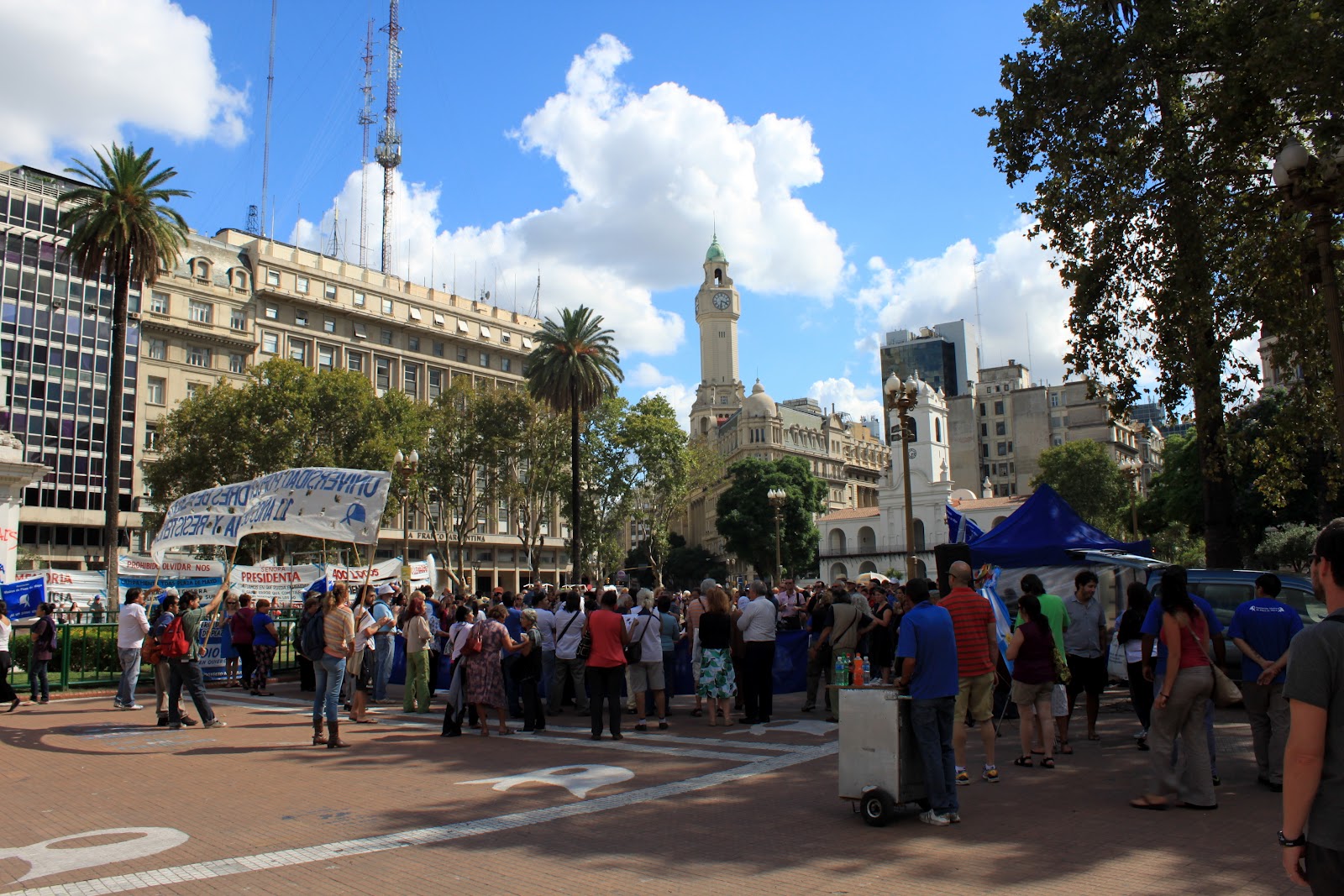
There is a huge movement by the mothers of the missing called Madres de Plaza de Mayo. They started as out small protestors in the 1970s, but now they are a huge organization and are corrupt. The good guys in this story are the grandmothers of the missing called the Abuelos de Plaza de Mayo. This organization is working hard to match the stolen children back up with their grandparents. It’s believed there were 600 children stolen during The Dirty War. Now those children are between the ages of 25-35 and they have matched 105 of them to their real grandparents. Imagine being one of those children and finding out that the parents who have raised you your entire life are not only yours, but that they sent your real parents to die. There are peaceful protests every week to remember the missing.


Argentina currently has a female president, Cristina Fernandez de Kirchner. Her husband used to be the President. After his term ended, she was elected President and he passed away right before her second-term elections. The story on the street is that she received a lot of sympathy (and paid for a lot of votes), and consequently was reelected. But everyone seems to have short-term memory loss. They voted her in, but no one likes her! It is openly joked that she is corrupt and doesn’t work very much.

The presidential residence is about 20 kilometers outside of Buenos Aires. Cristina takes a helicopter into the city every day and “works” at Casa Rosada or “The Pink House”. This is the Argentine version of The White House. Why is Casa Rosada pink? Our tour guide told us that no one knows for sure. The most widely accepted theory is that they didn’t have waterproof paint at the time of construction, so they mixed white paint with cow’s blood.


Casa Rosada is open for tours on Saturdays and Sundays. Compared to the White House tour we did early this year, we were surprised at how many rooms they let us see. We traipsed everywhere from the press room and inauguration room to the center balcony and the President’s office. By the way, Evita’s famous speeches were not done from the center balcony. She spoke from the balcony on the far left. Madonna was given access to film the balcony scenes of Evita at Casa Rosada, but she was only allowed on the balconies to the far right.


Compared to the White House, they have very few historical pieces of furniture or paintings on display. Instead, there is a lot of modern artwork and even a museum of sorts dedicated to pulp culture icons.

One night on our drive home from Puerto Madero, we were lucky enough to catch a glimpse of a blaring Casa Rosada out of the corner of our eyes. It was lit up like Disney World. Incredibly odd. This was so intriguing that we later asked out tour guide about it. He told us that the house has always been lit up in some capacity, but that Christina has taken it to a whole new level of tackiness.

March 9, 2012

The Art of Tango

How could we come to Buenos Aires and not learn to tango? After all, we had such a fun time with our samba lesson in Rio, and tango would help round out our growing repertoire.

Mary booked a babysitter and made reservations for the four of us to go to a tango club in Palermo Viejo last Friday night. It was a good sign when we got out of the cab and found the 8 steps of tango immortalized in the sidewalk.


Upon entering the club, it looked like a mix between the staff quarters in Dirty Dancing and a VFW hall. It was dark, hot and sweaty.


We got settled at our table right along the dance floor and ordered a bottle of wine. We couldn’t have asked for a better set-up. At about 10:00pm, pairings of professional dancers came out and showed everybody how tango should be done. Then the professionals split the crowd into 4 different groups based on experience. We proudly took our spots in the beginner group, and a very handsome young couple spent the next hour teaching us the basic steps. It was a good mix of showing us the steps individually and then letting us practice them with our partners. It was a little tricky, but we got the hang of it pretty quickly.

After our lesson was over, they turned on the house music and it was time to tango. It’s said that when a man wants to dance tango with a women, he makes contact with her from across the room by giving her “eyes”. There was no eye action going on at our table, but there were plenty of suitors who would come by asking if Mary or I would like to dance. We took turns tangoing with our men and then with some randoms. It worked out well this way, because each time we’d dance with a stranger, we would pick up new moves or tricks that we would run back to share with the table.


The most mind boggling thing about tango is that NOBODY FOLLOWS THE STEPS! 
Samba only had 3 basic steps, and when we went to watch locals dance at the clubs, we would see them doing the same steps we learned but about 10 times faster. Tango was totally different. We learned the 8 basic steps and we had them down pat. But as soon as the dance floor opened up, we didn’t see any of the couples remotely executing them. They just danced organically, somehow knowing the next move that the other would make. Truly the art of tango.

After midnight, a live band came out. We had such a good time, but alas we were growing tired and were some of the first ones to leave…at 3:00am.

Subsequently, we’ve seen tango dancers on the streets around the city.


We’re still keeping our eyes peeled for those 8 basic steps. They’re all we’ve got.

March 8, 2012

Recoleta

The first time I ever heard of Recoleta Cemetery was in “The World” book that Steve gave me last year for Valentine’s Day. It was filled with our friends' highly recommended places to visit around the world. I remember reading Mrs. Moon from Ohio’s account of Recoleta, and I had been looking forward to seeing it with my own eyes ever since.

Recoleta Cemetery is where all of the wealthy and influential families in Buenos Aires have their final resting places. We’re talking presidents, generals, scientists, artists and professors. It’s right in the middle of the city surrounded by high walls. Walking by it on the outside, you can just barely make out the tops of statues. Upon entering the inside, you’re opened up to a maze of tall above-ground tombs, each one extremely unique and personal.


The cemetery offers free English tours twice a week, and this really enriched our experience. For me, there were two fascinating sides to the cemetery: the customs that provide the unwritten rules for operation, and the pure beauty of the tombs – each accompanied with some sort of back-story.

Upon first look, the tombs felt very similar to monuments that you would see sporadically placed around US cemeteries. But these aren’t just monuments; these are family tombs. All in all, there are 5,000 family tombs in Recoleta, and each tomb is required to have enough space to hold at least 18 coffins. Sometimes a couple of coffins might be displayed above ground level, but the majority of the coffins are stored in 2 or 3 underground rooms. They are accessed by a small staircase within the tomb that is typically covered by a grate when not in use.


Each tomb is absolutely one-of-a-kind and is designed to the family’s wishes. Some of them are small and hold just 18 caskets. Some of them are humongous, ornate, and even have family chapels inside. These are sacred places for families to come and pray and honor their loved ones. I really liked this, and wondered why we don't have this tradition in the US.


Sadly we saw a lot of small coffins, no bigger than 2 feet long, which hold the bones of deceased children. The ashes are stored in a corresponding urn.


The cemetery is extremely clean, and someone on our tour asked why it doesn’t smell. Apparently a body is placed inside a metal box that is sealed and then placed inside the wooden casket. If a metal box’s seal breaks, the caretaker will know by the smell, and the body must then be cremated. Cremation is also a necessary step if the family’s tomb becomes full and they have to cremate to make room for the next deceased family member.

There is a mix of tombs that are either extremely well maintained or forgotten by the families that own them, and thus, are dilapidated. Regardless of whether a family upkeeps their tomb and pays their annual taxes, the cemetery will never reclaim the property. It is the family’s forever until they sell it. The cemetery has long been full, but there are always a handful of properties for sale.


The tombs themselves are beautiful. It seems that every detail – from the design and stone used to the doorknobs and decorative statueshave meaning. It’s easy to stare at each tomb for awhile, just wondering about the family’s story. Here are a few of our favorites:

This is the tomb of Carlos Guido Spano, an important poet, and his family. Despite their individuality, all of the tombs throughout the cemetery at least had a geometric shape to them. This one was obviously different…it was inspired by nature. In addition to the cabin-like design, the cross is made to look like tree branches.


This tomb holds a 24-year old girl, Liliana Szaszak. She and her husband were in Innsbruck, Austria in the 1970s when an avalanche killed her in her hotel room. Her dog sits next to her, and there were fresh flowers in her hands on the day that we visited.

 
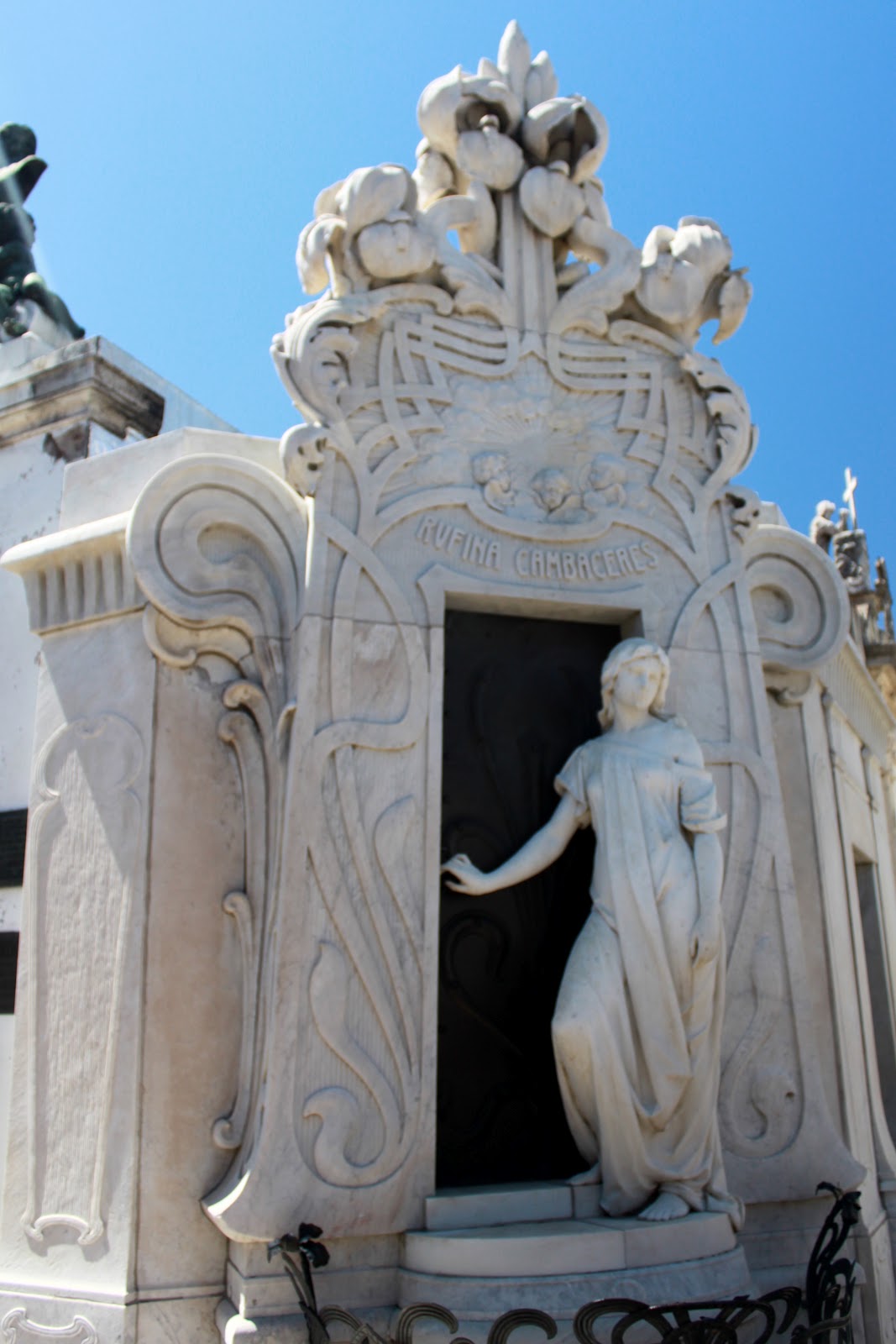
For us, the most memorable and haunting tomb was that of Rufina Cambaceres. In 1902 she had a case of narcolepsy, and on her 19th birthday her family found her asleep and thought she had died. She was buried alive. The following day the caretaker heard screams from inside the tomb and immediately alerted the girl’s mother. They opened up her casket to find her dead with scratch marks on her face. Her mother was so filled with guilt that they reburied her in a marble casket that lies behind a glass door, so that if she wakes up, she can be rescued. On the front of the tomb, the family placed a portrait statue of her reaching for the doorknob trying to get out. Buenos Aires now has a law that says no one can be buried until at least 12 hours after confirmed death.


The stories are endless and it would take years to learn and appreciate them all. Here's a link to a really impressive blog about the cemetery, if you're ever looking for some light reading.

It’s such a captivating place, that we’ve already gone back a second time and hope to go back a third time before we leave Buenos Aires.

March 7, 2012

Living Large in Buenos Aires

From Iguazu Falls, we embarked on another quintessential South American experience: the long bus ride. It’s an 18-hour overnight journey from Puerto Iguazu to Buenos Aires. We realize this may sound painful, but for many reasons, it was really the smartest choice. Busing is cheaper than an airline ticket, we don’t have to pay for a night’s lodging, and we get to see the countryside. Just like on an airplane, there are different classes of service. We decided to go 1st class all the way…for only about $20 more per person. On our double-decker bus, we had seats that folded down horizontally, wi-fi, movie screens, dinner, wine, beer, champagne, breakfast, and one heck of a sunrise along the Argentinean countryside.


Our time in Buenos Aires has been extra special because we have been staying with friends. Chris and Mary are friends of ours from San Diego who moved to Iowa several years ago. Chris’ company offered him an 18-month stint in Buenos Aires, so he and Mary moved down here about a year ago and have an adorable 8-month old daughter, Claire.


Living in a normal apartment has given us a much appreciated break from hostel life. Mary and Chris have been extremely gracious by opening up their home, their time, their tips, their food, and one of their comfy beds. We have been spoiled! Life has felt more normal here because of the little things – like sitting on a couch, going to the grocery store, cooking dinner, doing laundry, and not having to wear flip flops in the shower. We are forever indebted to our wonderful hosts!


Buenos Aires is a beautiful city – full of parks, monuments, tree-lined streets, and even purple jacaranda trees just like in San Diego. From the moment we arrived, it was obvious that Buenos Aires and Rio de Janeiro are very different worlds. We have traded in beaches and juice stands for parks and coffee shops. It’s cleaner and safer here, and the traffic isn’t nearly as deadly. But the main difference is that whereas Rio has a lot of iconic sites to visit, the beauty of Buenos Aires lies in everyday places. Let me put it this way…I would vacation in 
Rio de Janeiro, but I would live in Buenos Aires.

In pockets throughout the Buenos Aires, we have felt the bustle of Times Square, the trendiness of SoHo, and the elegance of the Upper East Side. Mix that with French, Italian and Spanish architectural influences, and Buenos Aires leaves a lasting impression. The city is made up of many different neighborhoods that each have their own identity and charm…

Chris and Mary live along embassy row in a residential neighborhood called Palermo. It’s a very walkable section of the city and prime people-watching territory. There are sub-sections of Palermo, and we have explored them all. We have sipped coffee in Palermo Chico, shopped the boutiques in Palermo SoHo, dined in Palermo Hollywood, and tangoed in Palermo Viejo. If we were to ever come back, this area of the city would undoubtedly be our home base.


Recoleta is just down the street from Chris and Mary’s apartment and one of the wealthiest neighborhoods of Buenos Aires. This is also where the world-famous Recoleta Cemetary is located (more on this in a subsequent post). We’ve enjoyed walking the streets of Recoleta while admiring the fancy buildings, hotels and stores.


Microcenter is the heartbeat of the city, and you cannot help but be invigorated when you go there. Avenida 9 de Julio is one of the widest boulevards in the world and one of BA’s more iconic sites, lined with tall buildings with an obelisk in the center. We were told by our local tour guide that the obelisk is the heart of Argentina. There are so many poor Argentineans who will never make it to Buenos Aires…but if they ever do make it, the obelisk is the first place they will come. Microcenter also houses Argentina’s government, including the Congress building and Casa Rosada – Argentina’s version of the White House. The most fascinating part of Argentina so far has been learning about all of their political history. They have so much baggage! More on the drama in a later post.


Puerto Madero is a newly refurbished section that lies along the old docks. The city has turned the rundown warehouses into a hip new center for dining and strolling. The centerpiece of Puerto Madero is the Puente de la Mujer bridge, which was inspired by two tango dancers. This neighborhood is also special to us because two of our Colorado friends, Noah and Heidi, got engaged on this bridge just a couple of years ago.


San Telmo is a known for its antique stores and Sunday street market. Of course there are people hawking jewelry and local goods, but one section of the market is particularly rich with antiques. It was fascinating to see the oddities that people have accumulated. We saw collections of everything from microscopes and turtle shells to bronze sink faucets and royal crowns. There are also tango dancers looming throughout the streets and in the cafes.


La Boca is small neighborhood along the water that is famous for El Caminito – a little grouping of streets with brightly colored buildings. This area was once the city’s main port, and Italian immigrants used leftover paint from the boats to color their houses. While listed as a “must do” in most travel guides, La Boca was easily our least favorite neighborhood. It was just way too touristy. The highlight of La Boca was walking the 5 blocks from El Caminito to La Bombonera, the world-famous soccer stadium, to see their version of the Walk of Fame. 


Regardless of which neighborhood you’re in, there are so many parks throughout Buenos Aires that it seems hard to go 10 blocks without stumbling upon another one. Our two favorite parks have been the Botanical Gardens in Palermo SoHo and the rose garden in Parque Tres de Febrero in Palermo Chico. We have spent many hours in the parks reading, running and relaxing. An added bonus is that there are dog walkers galore.


Three silly observations about Buenos Aires...

First, school was just starting back up during our first days in the city. It was impossible to miss the children because they all wear little white lab coats as school uniforms. It looks like the city is being taken over by tiny scientists.


Second, public transportation is difficult. It feels like only 50% of the streets actually have street signs and the bus system is comical. There are no bus stops, just numbered stickers on light poles that are so faded you can barely read them. One night we were coming home from dinner and a local had to help us find our “stop”. It was marked by a spray painted number on a piece of cardboard that was stapled to a tree.

Third, and easily the winner…even when it’s sunny, it seems to always be “raining”. These constant drips are from one of two things: (1) the air conditioning units in sky rise windows or (2) a parasite that lives in the trees and (no joke) pees on you.

We were so happy to learn that we happened to plan our trip during a leap year. This gave us one extra day of gallivanting, and lucky us, we got to spend it in this amazing city.


Life is good in Buenos Aires!