August 15, 2012

Aussie Rules

After 24-hours of flying and 24-hours in Shanghai, we finally made it Down Under. Our plan is to spend the next 4 weeks working our way up the Eastern Coast of Australia. Our first stop was Melbourne, where the people give off an effortlessly cool vibe and can talk intelligently about food, drink, fashion, sport, music and art.

Melbourne feels like a mix between Vancouver and Portland with a dash of artsy Barcelona thrown in. This city is not afraid of a little color.


Melbourne is full of beautifully landscaped parks, museums, sports stadiums, and cozy coffee shops. Everything is very vegetarian / gluten / vegan conscious. We even saw our first ever vegan shoe store, where you can purchase cruelty-free boots.

The downtown is packed with intriguing little arcades and lane-ways that lead to unpublicized restaurants, stores, and cafes. It feels like Melbourne is a place where you discover – and then trial-and-error – your favorite hang-outs over a long period of time. Thanks to Shanghai we only got 36 hours, which is practically embarrassing to admit.


We based ourselves out of the hip little neighborhood of Fitzroy, where we became coffee drinkers for 1.5 days. On the other side of town is St. Kilda, a dead-on replica of Pacific Beach in San Diego. Honestly, if we closed our eyes and got dropped on St. Kilda’s main street, we would have thought it was our old stomping grounds.

This is our friend Bella, who we met in Brazil earlier this year during Carnival.


Bella lives in Melbourne, so as soon as we stepped off the plane, she gave us a tour of her city. After taking us to get an obligatory vegetarian meal with a coffee, our next stop was the stadium…


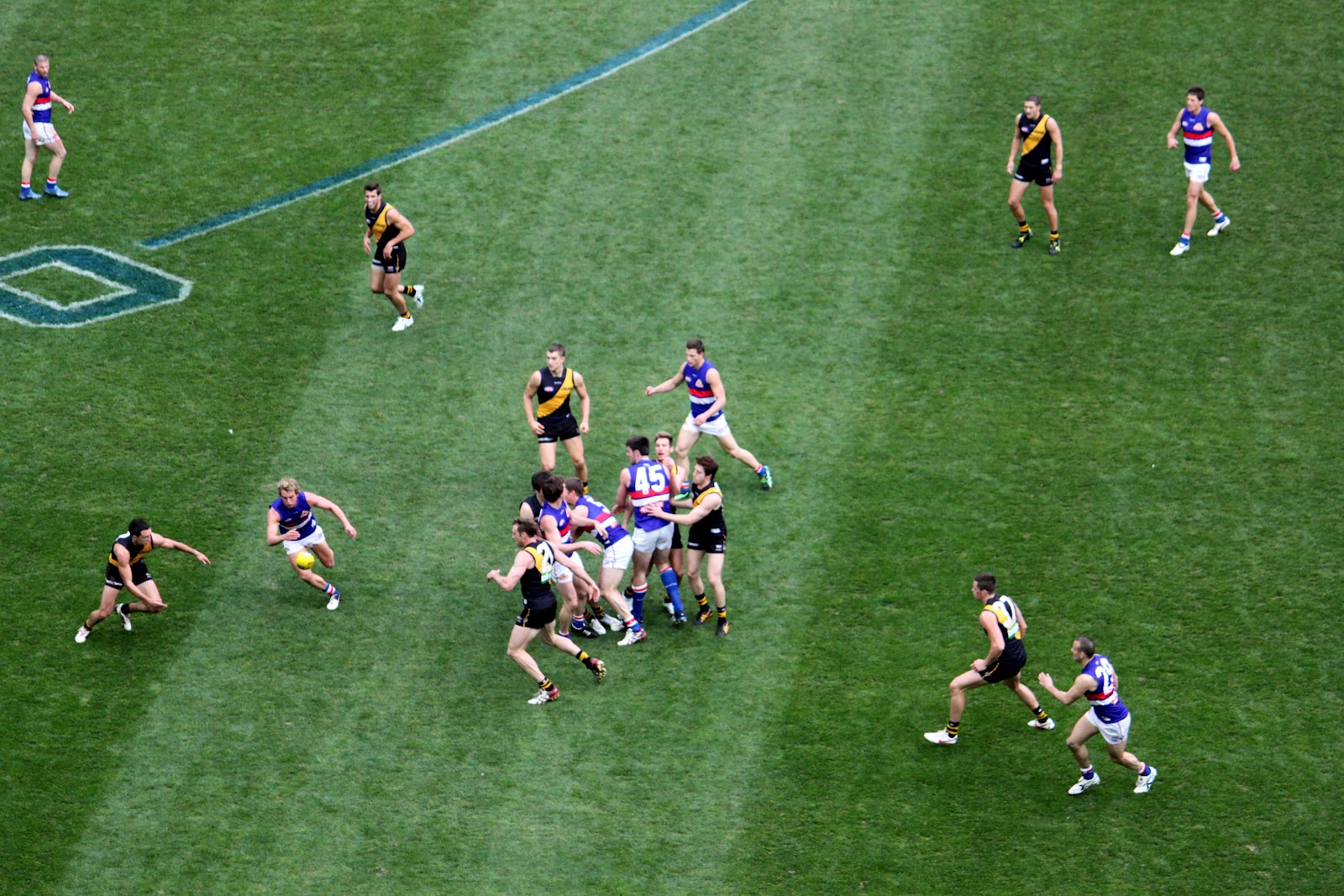
Aussie Rules is officially known as Australian football, but it also goes by football, Aussie football, or my favorite…“footy”.

We caught an evening game between the Richmond Tigers and the Western Bulldogs, both of whom hail from Melbourne. In fact, 10 of the 18 teams in the AFL (Australian Football League) are from Melbourne.

We watched the game at Melbourne’s famous MCG Stadium. I know what you were thinking. That doesn’t stand for Miller Genuine Draft. It stands for Melbourne Cricket Grounds. Australian Football was invented in Melbourne as a way to keep cricket players fit during the off-season.

To our novice eyes, footy is a mix between American football, soccer, rugby and basketball. The highlights are the high scoring games, precise kicking, and high jumping.


It’s not a very complicated game. We read the rules on the plane ride over. Within 10 minutes of watching it live, we pretty much understood what was going on.

Both the ball and the field are elliptical in shape. There are 18 players from each team, 9 referees, and 2 messengers. You read that right…messengers. Along with the team doctors and waterboys, all of these people can stay on the field even when the ball’s in play. This means that there could technically be 51 people on the field at one time. It’s mass chaos.

Just as entertaining to watch are the loyal fans who abide by strict “members reserve dress regulations” of “neat casual” – their words, not mine. This means they must wear collared shirts and absolutely will not be allowed into the stadium if they have on workout gear, ripped clothes, or beachwear. What is this, church? They’re also not allowed to wear thongs. For all of the Americans reading this, that means flip flops.

The fans wear scarves which make them look like they’re watching Harry Potter in a Quidditch match.


There are no cheerleaders, but the crew from Hogwarts waves the world’s largest pompoms behind the goalposts.


Wait, what is going on? It’s cold here! Wasn’t it just 5 days ago that we were laying like beached whales on a bunch of rocks in Croatia? We were having ocean withdrawal, so we spent 2 days driving and playing along the Great Ocean Road.


We’re not sure how we went our entire lives without knowing that Australians drive on the other side of the road and from the other side of the car. However unlike in Great Britain, the levers for the turn signal and windshield wipers are reversed. Our windshield wipers are on a lot. When it’s sunny.

3 days would have been ideal along the Great Ocean Road, and it would have easily been possible to spend an entire week moseying from site to site. But as the Aussies would say, we’ve got “heaps to see” and so we had to pick sites along the way. Our top highlights were:

Bells Beach, which hosts the longest continuously running surf contest in the world. This is also where surf shops like Rip Curl and Quicksilver got their start.


Loch Ard Gorge along Shipwreck Beach, where the only 2 survivors of an 1878 shipwreck washed ashore on this stunning piece of land.


12 Apostles, a set of limestone stacks that run along the coast. There are new apostles forming all the time; you'll just need to wait a few centuries to see the erosion finish its job.


There are so many more little stops along the way – Melba Gully, The Arch, London Bridge, The Grotto, Bay of Maytyrs – that make this an unforgettable drive. If you’ve ever done the Bur Sur drive in California, this is better.


There are also incredible beaches along the Great Ocean Road. We didn’t get to fully enjoy them because it was too cold, but we’re sure they are fabulous in the summer. On the flip side, we were literally the only people in the whole of Tower Hill Nature Reserve, and we had the entire Gibson Steps beach in front of the 12 Apostles to ourselves. Off-season has its perks, too.


Aside from the natural beauty of this drive, the most special part for us was the wildlife. Within 30 hours of landing in Australia, we had up close encounters with wild kangaroos, koalas, cockatoos, parrots, glowworms, wallabies, emus, and black swans.


We had moments when we could stand in place and see 17 koalas or 9 emus at one time. We watched a baby koala hang backwards out of its mother’s pouch while it chomped on a eucalyptus leaf. We laughed as a baby kangaroo got so scared when it spotted us that it dove into its mother’s pouch with its legs still flailing outside. We had to keep reminding ourselves that we weren’t in a zoo. These were all wild and natural occurrences.


If we had been in Europe, we would have paid 3 toll fees and 10 entrance fees by the time we ended the Great Ocean Road. In Australia, all of these incredible experiences are free! Don’t get me wrong…Australia can be ridiculously expensive when it comes to food and transportation, but the nature is fair game for all to enjoy.


Our first impression is that Australia is very civilized. They run a tight ship here. There’s no ambiguity when it comes to things like parking spaces or menu prices. The rules are clearly marked. Australia also feels like the closest thing to home since we’ve started our trip. The weather is just like San Diego in the wintertime, the restaurants have a point of view, and everyone is speaking English! The Aussies Rule.

August 11, 2012

Surprise! We’re In Shanghai!


Thought we were headed to Australia? Yeah, so did we.

Typhoon Haikui made landfall a day before our layover in Shanghai, and we “missed” our connection. By missed, I mean that our airplane to Melbourne was still on the ground when we landed, and the airline wouldn’t even let us attempt to make the connection. They just stonewalled us and told us it was impossible. “Impossible” to rebook on another airline; “Impossible” to take a flight the following morning; “Impossible” to talk to someone legitimate at a ticket counter who actually has a computer in front of them. We don’t know if the problem was the airline, the culture, or the typhoon, but we were so frustrated. We had places to be and people to see in Melbourne.

On the bright side, it meant that we got 24 hours in the most developed of China’s mainland cities. It obviously wasn’t enough time to do Shanghai justice, but we did get to hit the highlights, like…

The smog…which made me feel confused. It looked overcast outside, but we could still see our shadows.

A maglev train, which levitates off the tracks and is accelerated up to 300 km/hour solely by magnets.

Authentic Chinese food – flat fried beef noodles and shrimp dumplings.


We got censored by the Chinese government…no Facebook, and Google only worked half the time.

We got pushed (and did a little pushing ourselves) in the subway.

We also got two neat passport stamps without all the hassles of having to get a Chinese visa.

Shanghai is a sprawling – and I mean huge – city with a juxtaposed nucleus. A river cuts the downtown into two halves. On one side is the old town (Puxi) with a neighborhood of pagodas and a riverfront promenade lined with Western architecture.


On the other side is the new town (Pudong) in all of its skyscraper glory.

 
All-in-all a good detour to see a culture unlike anywhere else we’ve been.

August 9, 2012

102 Days In Europe

We have spent the last 3.5 months traveling through the Netherlands, Belgium, England, Ireland, Scotland, Spain, Italy, France, Slovenia, Croatia, and Montenegro. Whew!

ON EUROPE…
 
We have experienced amazing things. The biggest of cities and the smallest of villages. Ancient ruins and modern public art. Great food and drink. Wooden clogs and flamenco heels. Tulips and lavender. Cold and hot. Royal palaces and former war zones. Nature’s wonders. Planes, buses, cars, gondolas, boats, chairlifts, trains, trams and trolleys.

It really is amazing to see firsthand how many different cultures are packed together in such a small area. Basic things like food, dress, language, customs, and personalities change drastically just by crossing an imaginary line. Sometimes – like in Italy – they’re even more drastic within the imaginary lines.

As we progressed through Europe from England to Spain and Italy, a lot of what we learned in South America really came into perspective. For example, dates and names we had heard about while visiting Inca ruins made a lot more sense when we got to Spain. It was a good reminder of how interconnected the world really is.

Europe is advanced – in many ways more so than the United States. But there have still been things that have baffled us. Life’s simple expectations that we have as Americans just do not exist over here…like shower curtains, free tap water, double beds, pre-cut pizzas, washcloths, adequate coin circulation, cold beer, mounted shower heads, free bathrooms, drivers who don’t swerve into oncoming traffic, train tickets that actually show the train number and departure time, and construction sites that are closed to the public. 


It seems that everything in Europe is either under construction or “under restoration”. It’s hard not to find a main attraction that isn’t partly covered in scaffolding. What’s unbelievable is that places still charge full-price to see something even if you can’t see it…and they don’t tell you in advance! In 10 years I guess I’ll have to come back to see that restoration work I paid for.


In honor of the ridiculous number of churches that we’ve passed through, here are our top picks:

Favorite big church #1: Sagrada Familia (Barcelona, Spain)
Favorite big church #2: Siena (Italy)
Favorite small church: Bled (Slovenia)

We have completely lucked out when it comes to being in Europe during epic sporting events. From the moment we landed in Amsterdam all the way through Florence, we enjoyed 3 whole months of European soccer championships and the Euro Cup – played every 4 years on an alternating schedule with the World Cup. We were the worst fair-weather fans of all time…cheering for whichever country we happened to be in at the moment. There was a televised game every night and the restaurants would wheel big screen TVs into the squares for everyone to watch while they dined.


Have you ever wondered which Olympic sports other countries watch on TV? I did, but then it got old after one day. NBC has censored us by blocking all online videos from being shown outside of the US. So at first we were forced to watch what the Croatians deem important….ping pong and handball. Finally we got to some places with satellite TV and saw cool events like triathlon, marathon, tennis, gymnastics, swimming, and track and field (which they call “athletics”). Still, I miss Bob Costas and his crazy toupee.

Have I mentioned that European “beaches” are 99% rocks? Sure I have, but I’ll rant about it again. How can an entire developed continent – which enjoys all of life’s other luxuries – put up with this? I mean honestly, after laying on rocks for 30 minutes it looks like you have a skin disease. Americans, please, get out there and enjoy your sandy beaches. Frolic on them. Roll around in them. Take a nap on them simply because you’re so damn comfortable. I’m not sure we realize how good we have it.


European cars are like micro-machines. 


At any given time, Europeans (more specifically in the Mediterranean) are either holding a cigarette or an ice cream cone.

If European fashion is any sort of precursor to American fashion, then I predict that Birkenstocks will be making a comeback. They were everywhere in Italy. That’s right, the shoe of 1997 is back. This has made me realize that I have now reached the age when I can spot 15-year fashion cycles.


If the French get their way, chic fanny packs are right around the corner. Prepare yourselves.

Europe. It’s a real class act.


ON OUR STATE OF WELL-BEING…

While watching the Opening Ceremonies, I had a startling realization. The TV was on mute, and when I would sporadically glance over at the parade of athletes, I could correctly identify the country within 3 seconds solely by seeing the flag bearer’s face. I realized how much I had broadened my horizons.

Before getting to Europe, fellow travelers had scared us about the quality of the hostels and the lack of Internet. Neither of these turned out to be a problem at all. Our other major worry was the heat. This was a problem, and there were some days I thought I might go crazy. It was particularly hot in Spain, Italy and Croatia, but we powered through.

Trip planning in Europe was so much harder than in South America. In countries like Bolivia, there may only be 3 or 4 cities that 90% of people visit. That makes it easy because it’s fairly obvious what to choose. In Europe everything is so nice that there are endless options. That was difficult for us because (1) we didn’t have time to research everything and (2) we can be a bit indecisive.

While we were still vigilant throughout Europe, it’s been more relaxing to know that we didn’t have a bullseye on our bags. People weren’t waiting to steal our stuff at any moment. We could actually go into the ocean at the same time together, which is something we didn’t feel like we could do in Brazil.

Here’s a funny thing about communicating…you don’t necessarily need to speak a country’s language. You just need to be able to speak their back-up language. We managed to get by in Italy and France and counted our blessings that we are from an English-speaking country. But if you’re from Russia, what do you do? We have no clue.

I have an ice cream problem. I’ve had so much of it that I’ve become dependent. At the end of the day, I crave ice cream like a gainfully employed adult craves a glass of wine.

On a related note, several people have commented about Steve’s weight loss. On our flight to the Aran Islands in Ireland, our plane was so small that they had to weigh us to balance out the plane. This was when Steve discovered that he’s lost thirty pounds since we left San Diego! Everyone’s reaction has been pretty unanimous…nobody thought he had anything to lose. From the sweets of Belgium and the fried food of Great Britain to the tapas of Spain and the carbs of Italy, we have eaten well. This just goes to show what getting out from behind your cubicle desk can do. We walk a lot. Activity…it’s good stuff.

We’ve been traveling for 6 months now and the wear and tear on our equipment is starting to show. Halfway through Italy all of our stuff started to break. The zipper on my backpack spontaneously combusted, my flip flop blew out, and the sole on my running shoe is peeling back. To make matters really worse, the flash on our camera stopped working, our iPhone freezes, the iPhone case cracked, the Kindle case ripped, and the ‘h’, ‘g’, apostrophe and backspace keys are our laptop intermittently decide they need a day off. All of these technology problems are not good news for a pair of flashpackers.

These tribulations just been magnified by the fact that we’ve been moving so quickly the last 2 months…changing cities sometimes almost every night. Lately we have been feeling more stressed out than we think we should be for having a year off.

We’ve made mistakes – especially in Italy – with trains, hotels, tolls, and the Dolomites hiking mishap. We chalk it up to how fast we’ve been traveling. We set a blistering pace for ourselves that we just haven’t been able to keep up with. It’s been a reminder that we really didn’t know what we were doing when we first planned our trip. We wanted to try out different paces to see what we liked. This was a test, and we learned a valuable lesson about what our limits are. Steve said it best, “The last month and a half has been fun but hard. If we were to keep up this pace, it would be hard to have fun.”

In the midst of all this madness, we’ve also had annoyances back at home. We’ve basically had to evict our tenants in San Diego and we were victims of credit card fraud – in the US of all places. Lately we’ve felt like we’ve gone through a gauntlet of bad luck. We completely expected to have some low points on our trip. After all, you can’t have the highs without the lows, right? We are trying to get our balance back in order.

In the exact same way that we felt three months ago when we left South America, we are ready to go but a little scared to leave. We’ve learned that 3 months is about the limit for how much time we can spend in one continent before getting stir crazy. When we arrived in our final city of Kotor in Montenegro and we weren’t marveling, we knew it was time to move on from Europe. This city deserved to be marveled at. At the same time, we have learned the European system. We’re in our comfort zone (as much as that’s possible), and the thought of starting over is daunting and scary.

But then we remind ourselves that we’ve done it before and we can do it again. Hey, it’s springtime in Australia! A fresh start sounds perfect.


August 8, 2012

Montenegro On A Whirlwind

Montenegro is a country smaller than Connecticut and just 45 minutes south of Dubrovnik. It also was a part of the former Yugoslavia, but while Slovenia and Croatia gained their independence in 1991, Montenegro didn’t completely break free from Serbia until 2006. Now it’s one of Europe’s youngest countries trying to find its identity.
We rented a car and passed through customs picking up what must be the world’s simplest passport stamp. Then we spent the rest of the day exploring Montenegro’s Bay of Kotor.


The bay itself is a quirky place with mussel farms, an arthritic treatment spa popular with Scandinavians, and the locally self-proclaimed world's smallest river. Quite the mix.


Hidden back within the fjord, the town of Kotor was the highlight to our day. Its Old Town is in the shape of a triangle protected by the bay, a moat, and a steep cliff with fortified walls and a castle on top.


It might have been about 100 degrees outside, but during the hottest part of the day, we decided to hike the walls.


Even after all of the walled cities we’ve been to, none have been quite like this…a zigzagged network of switchbacks that looks more like the Great Wall of China than anything else.


It was so worth it. The view at the top speaks for itself.


With 75% Eastern Orthodox Christians, 13% Muslims, and 1% Catholics, Montenegro was a nice cultural change of pace from the rest of Europe that we’ve seen.


Montenegro is trying to cultivate its image as a high-roller luxury paradise, while struggling to upgrade its sometimes third world infrastructure. We didn’t go into it expecting any sort luxury, and we left happy with their lower prices, friendly locals, and rugged beauty.

We heard that Montenegro is the next Croatia. And we read that Croatia is the next Italy. So does that mean that Montenegro is the next, next Italy? Ummm, okay, but I’ll give them the next century or so to work that out.

August 7, 2012

Sunbaking In Croatia

It’s August, and that means it’s time for Europeans to skip out on work for an entire month. We decided to vacation like the Europeans do, so we headed to scorching Croatia. Our ultimate goal was to spend 10 days city and island hopping along the Dalmatia Coast, but first we made a few inland stops…

We started in the capital of Zagreb.


Croatia is set to join the European Union next year, and the flags are already flying. These relatively young capital cities like Ljubljana (Slovenia) and Zagreb are funny. Government just does not seem like a big deal here. Besides one security guard, we were pretty much the only people standing in the square where the country's President and Prime Minister work.


From Zagreb we bused down to Plitvice National Park, where limestone rock and calcium carbonate rich water create a complex of clear blue waterfalls.


The falls don’t compare to Iguazu in Brazil/Argentina, and the water is not as perfectly pristine as the Soca River in Slovenia. Steve says I’m being too hard on Plitvice. It’s true that this is not something you get to see every day.


Like Pompeii, I found the park management to be incredibly frustrating. We had gotten used to the Germanic efficiencies of Northern Italy and Slovenia. It was an adjustment to come back to a lackadaisical culture, where the people want your tourist dollar but they’re not very helpful in exchange.

Side note…we noticed that the girls here wear skanky outfits in the most inappropriate places. For example, this girl was sporting a New Years Eve party dress through the national park.


It was time to make a beeline to the Dalmatia Coast. First stop: Split.

Most people just use this as a transportation hub to the islands, but Split deserves more credit than that. We liked it so much that we decided to stay a second night.


In 305 AD, the Roman emperor Diocletian decided to retire in his homeland of Croatia, so he built a massive seafront palace in Split. After his death, the villagers set up shop inside the abandoned palace, and since then, pretty much nothing has changed. There have been some buildings added and a little restoration work done, but all-in-all, the modern city of Split is centered smack dab in the middle of the emperor’s palace for all to enjoy. Take these people...they have seat cushions and are sipping cocktails on the steps of the Emperor's mausoleum. No big deal.


It’s an unusual and fun sight to see people of today using and taking such pleasure in antiquity. Throughout Europe we’ve visited so many Old Towns that are oozing with charm. But to be honest, their narrow winding streets, cobblestones and archways are all starting to feel a little similar. Split is an exception. Nowhere else do you get to dine, listen to street musicians, and lick ice cream as you stroll through the former Roman Emperor’s palace.

One night after dinner, the palace’s former living room square was full of salsa dancers. The next minute an instructor was leading everyone in a sequence of hip hop moves. It was just crazy to think that all of this was going down less than five feet from Diocletian's burial site. Maybe he’s rolling in his grave watching this night after night, but we thought it was really cool.


From Split it’s just a short boat ride to some of Croatia’s most famous islands. Hvar is the hippest and most jet-set of the islands. 


With its cliff hugging bars, waterfront lounge beds, and DJs blasting music that you can hear across the island, we thought Hvar would be the perfect place for college spring breakers.


But then at night Hvar turns magical, even for older kids like us. Crowds are out enjoying late dinners in romantically lit alleys, and there's a fun summer night vibe in the air.


Hvar is just as happening as Nice, but I think it deserves even more credit given its size and relative obscurity.


In contrast, Korcula is the sleepy little hometown of Marco Polo. The Old Town is circled by defensive walls and connected to the rest of the island by a grand staircase.


This is Korcula’s "main street". It’s 6 feet wide. 


All of Korcula's other streets branch off of the main street like ribs on a fish’s backbone. We loved Korcula. It had yummy seafood, good swimming, a sandy beach (which you had to haul across the island to get to), and it didn’t hurt that we scored a cottage in the heart of Old Town with views to the sea and city walls for only 60 Euros. 


Our final island was Mljet National Park, where it's all about nature. We hiked to the island’s highest point for sunset. At the top of the mountain there’s a wooden shack where locals take turns on fire patrol. So there we were…all three of us…enjoying this romantic sunset together.


Mljet has two saltwater lakes which we enjoyed by boating, biking and floating. I say floating because the water is super salty. We loved drifting down this natural lazy river. 


While Mljet was pretty, it was also pretty weird. The towns are so small that they only take up one side of one road. Within a 15-minute period we had four really terrible encounters with local people. We found them to be rude, unhelpful and dishonest. Aren’t island people supposed to be happy and carefree?

All across the Croatian islands, it seems the local people are living in a pre-Internet world. The hotel options are terrible, so the best place to stay is in a "sobe" – similar to a bed & breakfast in England, but without the breakfast. It can be impossible to book a sobe in advance. These people have email addresses, but reservation requests must get lost in outer space. It requires a real go-with-the-flow attitude to step off the boat and make contact with local sobe owners who are trolling the docks for nightly guests.

Even the sobe owners who are a little more technologically savvy still do things the old-fashioned way. We actually had a reservation in Korcula, and when we stepped off the boat, our sobe owner was there to greet us like a chauffeur at the airport. She was holding a STEVE NAUMAN sign written in bright highlighter.

I have to say, the Croatian islands were not what we had imagined. They are much bigger than we expected. And arid. They're not tropical at all. There are no sandy beaches…just rocks, lava spew, and concrete slabs. During the day there’s really not much to do except to lay on your concrete perch. People don’t sunbathe here, they sunbake. And nap. I took four naps in one day.


Call me crazy, but I think it’s kind of dumb to take a beach vacation in a place that has no beach. Fortunately we’re not on vacation. We’re traveling, which means that we’re allowed to chalk this up as a cultural experience.

Months ago we toyed with the idea of booking a week-long sailing trip around the islands. We’re glad we didn’t go that route because (1) I would have most certainly been seasick the entire time and (2) we heard from several sailing travelers that they didn’t get to spend enough time in port. That's a shame because I think it’s the cities that make these islands worthwhile…not the islands themselves.

Are we jaded? Maybe so. We’re worried that we’ve gotten a little picky. We’ve seen so many amazing things these past six months that some of the nice – but not astounding – places feel a little mediocre. We’re attempting to snap out of that attitude.

Nevertheless, we were excited to get back to mainland civilization and our final Croatian destination...the Pearl of the Adriatic...Dubrovnik


This is such a special city that we spent five nights and we still didn’t want to leave. Dubrovnik’s Old Town is just as charming and quaint as a small village, but it’s big. It’s probably the biggest Old Town we’ve seen throughout Europe. It juts out into the sea and is completely surrounded by huge medieval walls which you can climb and walk on.

I kept thinking that if this was the first European city someone ever visited, and they went on top of those walls, it would completely blow their mind.


Dubrovnik was probably our favorite place to swim in Croatia. It’s hard to beat a swimming hole that’s 5 minutes outside of a heavily fortified city in water with at least 20 feet visibility. The Adriatic Sea is so blue, clear, and beautiful.


Dubrovnik is also a living war museum. When Croatia violently separated from Yugoslavia in 1991, Dubrovnik was the only coastal city to be pulled into the fighting. It was senseless. Yugoslavia wanted to hit Croatia where it hurt, so they bombed their most beautiful city. The townspeople had to take cover within the city walls, which was the first time in Dubrovnik’s long history that the walls were actually used for defense against an attack.


More than 300 people died and two-thirds of the buildings were damaged. Dubrovnik rebuilt. Except for the new roof tiles and a few pockmarks in stone facades, you wouldn’t be able to tell that the city had just come through a war. Now the damage just lives on within the people. It was new for us to be in a city where every local person we met had lived in a war zone. Thankfully we saw it in happier times.


Changing subjects, have you ever been to a city where every item on every single menu is EXACTLY the same? That’s Dubrovnik. For as charismatic as the city is, their restaurants have no personality. So boring. We did get to try some new dishes like octopus salad and squid risotto. They were great; I just wouldn’t want to eat them 5 nights in a row.


We supplemented with Croatian staples of pizza and pasta and the occasional fresh catch of the day.


We expected Croatia to be ahead of Slovenia in terms of infrastructure, technology, and customer service. But in fact, we experienced the opposite. It’s hard to even find a trash can.

We wouldn’t put a complete tour of Croatia on the top of our list, but if we had to do it over again Split, Hvar, Korcula, and Dubrovnik would be up there. And now we can say we’ve vacationed like the Europeans.