February 16, 2012

Juju & Toni

Last week we met up with a friend of a friend who is a Rio local and offered to show us around town. Julieni (Juju) is a former nun who now teaches religion for Brazilians ages 7-40. Her boyfriend, Antonio Marcus (Toni), is completing his doctorate in theology.


Given that we speak next to no Portuguese, and they speak little English, we sometimes had to rely on a mutually limited knowledge of Spanish to communicate. For anyone who knows the extent to which Steve and I speak Spanish, you can imagine how comical this situation must have been. We couldn’t find a Portuguese-English dictionary lying around the hostel, so we made due with the Portuguese-Spanish dictionary and substituted that with lots of hand motions.

Juju and Toni took us to the Jardim Botanico (Botanical Gardens) so that we could see some of Brazil’s native flora. If North America has 150 different kinds of orchid species, Brazil alone has over 8,000.


Coming from San Diego, we found the various palm trees interesting...all of the palms we saw from the Amazon region carry an added layer of protection.


But easily our favorite, was an amazing type of lily pad called the Victoria Longwood Hybrid Water Lily. It is native to the Amazon and can grow up to 8 feet wide.


We very much enjoyed our time around town with Juju and Toni. Thank you, Angel Garcia Rodriguez, for introducing us!

February 15, 2012

Favelas

After spending time in the more upscale neighborhoods of Ipanema, Copacabana, Leblon and Santa Teresa, we wanted some insight into how the other side of Rio lives. We found a very reputable company who, for 19 years, has been giving tours of favelas – the iconic shanty villages sitting throughout the hillsides of Rio.


Currently there are 950 favelas in Rio. The people who live in them are the cooks, doormen, maids and gardeners from the nicer neighborhoods I mentioned above. They live in the favelas because their wages simply aren’t enough to pay for more traditional housing. The government can fix this, but they don’t. While most of the world reads about the favelas being such a problem, in fact, the favelas are a solution because these people have nowhere else to go.

We visited the largest favela, Rocinha, which has 70,000 residents. Before coming to Rio, we had always heard about how close the rich and poor neighborhoods are to each other. This was never more evident than on the drive up to Rocinha. Wealthy Rio parents pay $2,500 per month to send their children to the fancy American school, which sits a mere 100 feet away from the entrance into Rocinha. The entire road up to Rocinha was lined with chauffeurs waiting to pick the children up from school.

The infrastructure of the buildings is astounding. With the exception of what they call “Main Street”, there are no roads. Each house is connected through a system of tunnels, alleyways, and stairs. The houses were largely built by construction workers who decided they wanted to start their own companies. That leaves the favelas in a very vulnerable state because there has been no engineering factored in.

Rocinha is large enough to support branch offices for mainstream banks, pharmacies and grocery stores. Even McDonalds was in Rocinha, only to close its doors and then open back up again. Nearly every single house we saw had a satellite disk. They all have cable, Internet and air conditioning, but running water and the sewage system are hit or miss. The electrical wires are a mess, but they work.


Vila Canoas was the second favela we visited, and it was much smaller with only 3,000 residents. This place is the gold standard in favelas…all of the houses even have numbers. Unfortunately the public education system is very poor, and children only go to school for 4 hours per day. Our tour company partners with an afterschool program in Vila Canoas, so a portion of our money went toward paying for 70% of the program’s expenses. We got to meet several of the children, and they were enthralled with how light our eyes were.


We felt safe the entire time, and we're glad that we came to see how 20% of Rio's population lives. The Brazilian government is finally feeling pressure to help clean up the situation with the impending World Cup and Olympics coming to Rio in the next several years. They are starting to recognize the favela residents as citizens that, too, need clean water and power and security. We hope it only gets better from here.

It’s worth mentioning that the only negative experience of the entire visit was our fellow Americans on the tour. They were flashy with their expensive electronic equipment, rude to the tour guide, and overall, just an embarrassment to be around.

February 14, 2012

Carnival Part 1: Rio

It’s Carnival time in Brazil!

We like to think we’ve formulated a fairly airtight game plan. We’re staying in Rio right up until the start of Carnival, so that we can experience the lead-up but avoid the outrageous price gauging. For Carnival week itself, we will move to a more northern city named Salvador, where a less-formal and more beloved Carnival comes alive for the Brazilians.

Even though Carnival officially isn’t until the week leading up to Ash Wednesday (Feb 22nd), it has been alive in the streets from the day we landed here. I’ll do my best to summarize what I’ve witnessed and learned – from an outsider’s perspective…

Carnival includes everything from the grandiose pageantry to more casual street parades called “blocos”, which pop up throughout the city leading up to Carnival week. We have seen these informal blocos all over Rio and they can range from 4 people with drums to hundreds of people marching along with bands or sound systems. We’ve had two particularly funny bloco encounters.

One night before we left for Costa Verde, we got caught up in one of the blocos in Ipanema. It took us 30 minutes to march, dance, and drink our way through ONE city block.

The night we arrived back into Rio from Costa Verde, it was very late (past midnight). In order to get to our new hostel, our taxi driver had to barge right through one of the blocos! We were the epitome of fish in a fish bowl. Completely embarrassing at the moment it happened, but so funny now that we can reflect on it.

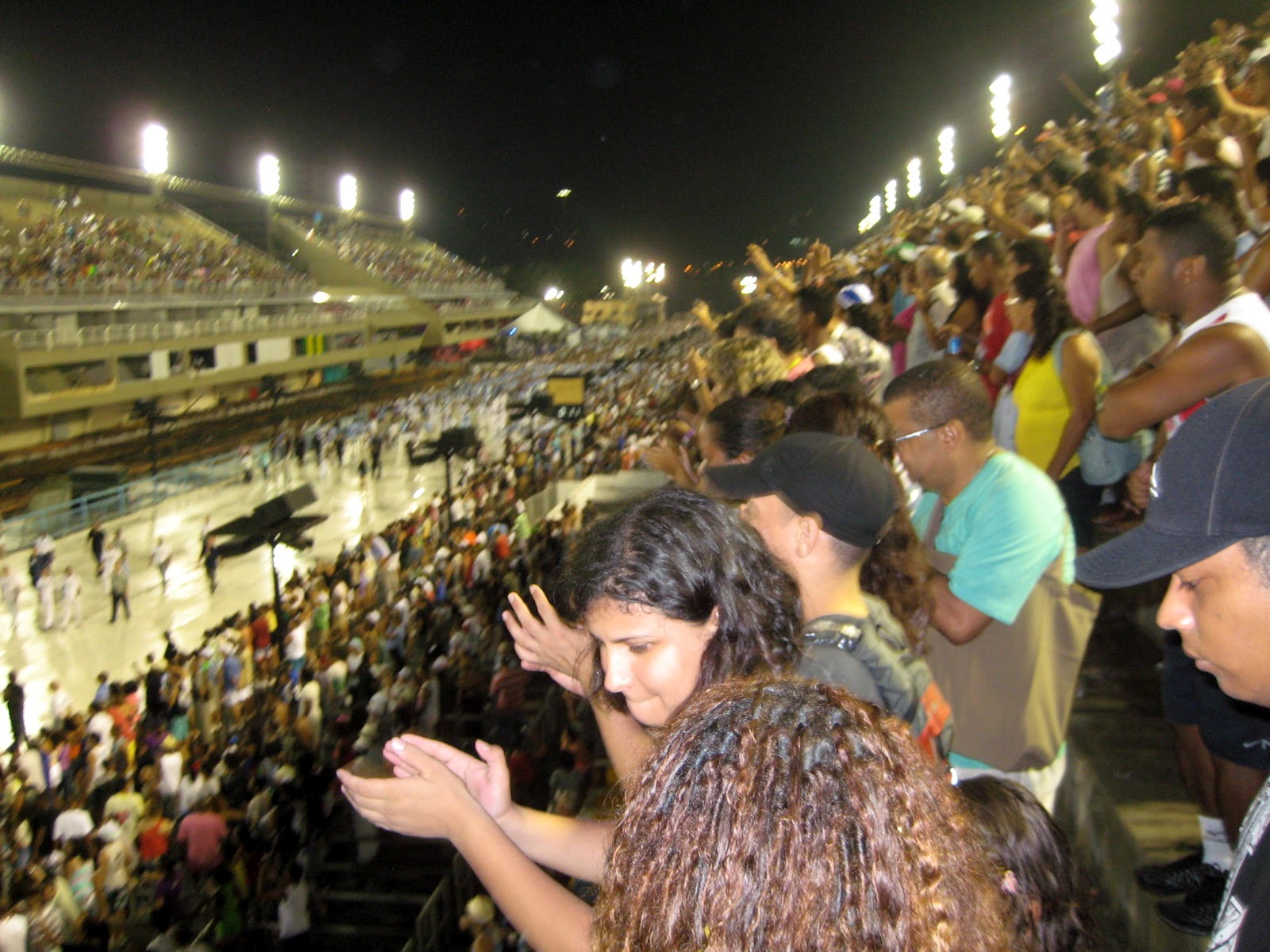
The other side to Rio’s Carnival is the more extravagant parading that probably comes to mind. Even though Carnival is celebrated throughout the world, Rio’s celebration is the largest and grandest. The main event takes place over several nights in the Sambadrome, which is a stadium built precisely for Carnival.


Different areas of Rio have what they call samba schools. These aren’t schools in the literal sense…they are just large social groups of 3,000-5,000 members working together on their school’s performance, which they will unveil at the Sambadrome come February. Each year the school chooses a theme, and everything about their performance must revolve around that theme – from music and floats to costumes and dance. The theme is chosen very far in advance so that they have 8 months to design and sew the costumes and record the music. Each school writes and records one song each year, and by Christmas time, all of the schools have released their songs to the radio stations so that everyone can learn the music ahead of time. So the large and over-the-top parading that you see on TV, is actually a competition between all of these samba schools. They are judged based on 10 different categories, and a winner is announced.

We carefully planned to be in Rio on the Sunday before Carnival because that’s when the organizers hold a final dress rehearsal with full sound and lighting at the Sambadrome. The best part…it’s FREE! We arrived early last night to make sure we would get a good seat. I think we were the only non-Brazilians in the entire place.


Right as the first samba school was being announced into the runway, the sky opened up and it began pouring rain. We thought for sure they would cancel it. They wouldn’t possibly want their costumes drenched one week before the big show, right? Well, they stuck it out and so did we.

Tradition states that the winning samba school from the previous year is invited to perform at the dress rehearsal. Luckily after two hours, the rain cleared up just in time for Beija-Flor to samba their award-winning selves right down the runway. It was spectacular. It takes over an hour for each school’s 3,000-5,000 members to make it from one end of the Sambadrome to the other. It was a never-ending parade and the spectators were dancing just as much as the schools!


As tradition also has it, after the previous year’s champions finished rehearsing, Rio’s biggest and most traditional street band lined up in the runway and played a lot of traditional samba songs. I couldn't believe it, but we were allowed right down on the runway.


If you’d like to read more about the Sambadrome parades, this is a fantastic site that explains all of the traditions in very easy to understand English.

Seeing the samba schools, and spectators, dancing last night inspired us. Today we took a samba lesson. Happy Valentine’s Day!

February 13, 2012

On Fitting In

We've spent a good amount of time in Rio, and it's pretty clear to everyone that I am not a local.

Reason #1: My language skills
I know English fairly well and I have a bit of Spanish knowledge. Reading the Portuguese language guide, I figured that Spanish and Portuguese were pretty similar. Boy was I wrong. Instead I'm here trying to talk with a mix of Spanglishuese where I don't even understand what I'm saying.  But even before I open my mouth, hawkers on the beach still ask me in English if I want water or beer.  I can only guess that it is because of one of the next reasons…

Reason #2: My tan
I get here and I am definitely on the ghostly side, so I think that must be a dead giveaway. But then I see all sorts of pale skinned people speaking Portuguese, so I guess that can't be the only reason.

Reason #3: My incredible body
As Katie mentioned earlier, the guys here know to take care of their bodies. I have never considered myself fat, but the guys between the ages of 18 and 35 definitely put me to shame. The all have a six-pack with pecks to match. Seriously, they must have less than 2% body fat! But people still walk up to me talking in English even when I’m wearing shirts, so again, that can't be the only reason, which brings me to number 4…

Reason #4: All my shirts have sleeves
Most of the guys in my age bracket seem to go around shirtless all the time (I guess I would with bodies like that), but nobody seems to own a shirt that has sleeves. It's crazy, I contemplated tearing the sleeves off my shirts but realized that they all cost way too much for that.

Reason #5: Speed-walking Americans
Lastly, Katie and I have noticed that we walk way too fast compared to everyone else. They all meander along at a very slow pace. I don't know if it's because of the heat or if no one really cares how long it takes to get from point A to point B. A Brazilian friend we’ve made told us that "time isn't money" in this country. Either way, we are now slowing down our pace and striving for a saunter.

The two things I definitely have going for me…my tattoo and my Havaianas.

February 10, 2012

Costa Verde

We decided to get out of the city for a bit, so we spent the last four days south of Rio, along Brazil’s Costa Verde or “Green Coast”. It’s a mountainous landscape along the water, which reminded us of Kauai, but more jungle-esque.


Our first stop was Paraty, a 17th century Portuguese colonial town. Before a road connected Rio and Sao Paulo, Paraty flew under the radar and it allowed the city to stay stuck in time. There are no cars in the historical center, and all of the streets – used only for pedestrian traffic – are made of the largest cobblestones we’ve ever seen. It’s a beautiful and romantic little escape along the water with charming buildings, squares and churches. There is constantly music in the air, and it’s not uncommon to see horses galloping by. At nighttime, wooden dining tables are placed down the center of the streets, and a post-dinner stroll is made even longer by the precaution you have to take navigating the humongous cobblestones. We were lucky enough to be there during a full moon, when the high tide flows through openings in the city walls, allowing water to fill the streets – much like Venice. The town feels a little touristy with its many stores, and we ran out of things to do after about 5 hours, but Paraty more than makes up for it with its beauty.


The next day we took a 45-minute bus ride to a beach village called Trindade. This was the start of our new routine: hiking, beaching, reading, napping, reading, beaching, hiking.


Then it was off to Ilha Grande, a large tropical island between Paraty and Rio that is known for its pristine Brazilian beaches. We liked everything about this island…no cars, dirt roads, nice hostels, cheap food, great hikes, and beaches that were made for postcards. Lopes Mendes is a beach that has been ranked as one of the top 10 beaches in the world. Like most great beaches, you have to hike to get there. Our catamaran to the island gave us a late start to the day, and several locals looked at us like we were aliens when we said that we were going to start the hike at 1:00pm. “Lopes Mendes?!? Noooooo. It’s impossible. It’s too far”. Well they didn’t know that they were dealing with two fast-walking Americans with some hiking experience. It was strenuous, but we made it in less than 2 hours. That gave us plenty of time to do what we’ve been doing best: beaching, reading, napping, and beaching. Lopes Mendes had the whitest and most powdery sand I've ever seen. It squeaked when we walked on it...I have no idea why. This hike ranked in our top 3 of all time (so far) due to the little beaches that we had to traverse before even getting to Lopes Mendes. We would work up a sweat on the uphill and then jump in the ocean to cool ourselves off before starting uphill again. We wish all hikes came with built-in coolers like this!


February 6, 2012

Rio the Maravilhosa

Rio de Janeiro is nicknamed Cidade Maravilhosa, or “Marvelous City”. Last night it surely was. While our friends and family in America were watching the Super Bowl, we paid a visit to Christ the Redeemer…


…and then did a combo hike / tram ride up to watch this sunset atop Sugarloaf Mountain.


February 5, 2012

Bucket List ?

The book, 1,000 Places To See Before You Die, says that while in Rio, you must go to the famous Copacabana Palace Hotel to have a drink by the pool. Does filling up our Nalgenes from the pool bathroom faucets and then sanitizing the water with our Steripen count? If so, I think we can check that one off the list.